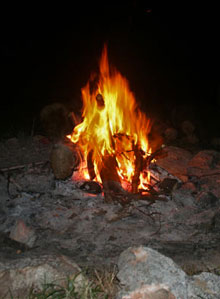
 The fire crackled merrily, stretching orange fingers into the black sky. Avril kept well back, not trusting its temporary solace. Last year an errant spark had leapt out and caught her skirt. The threadbare garment went up like a torch. She’d rolled in the sand while Mam slapped at the flames. Avril had been lucky. She ended up with a minor burn on one leg, mostly healed except for a small reddish gray area. Still, she didn’t want a repeat of that incident.
Across from her Johnny worked to fashion a knife from a piece of stone, using another piece of stone. She thought to tell him it was an exercise in futility, then changed her mind. She’d promised Mam she’d be less negative. Anyway, her brother had actually produced a couple of useful tools. He’d also had his fair share of failures.
She looked over at her mother. Mam pushed a strand of gray hair off her mottled brown face and reached a stick-thin arm behind her for some kindling. They were lucky to find deadfall along the trail, luckier still to have run across some sort of rodent who in turn led them back to the remains of its family living in a shallow crevice near a dried-up river. Dinner. Avril couldn’t remember the last time they’d eaten. Not that whatever it was they killed and cooked tasted good. That was a myth, that everything tasted good when you were starving. They forced it into their shrunken stomachs, though, along with tiny mouthfuls of water. Water was in even scarcer than usual this time of year. They needed to conserve. Soon they’d be traveling by night, pinned down during the day by an unforgiving sun that baked the life out of the earth. Unless, of course, the weather, or what passed for weather, changed again.
“God, what I wouldn’t give for a lemonade!” Avril exclaimed, more to make conversation than anything else. She surprised herself by recalling the sharp tang, softened by white sugar, the pale yellow liquid in a sweating glass. Lemonade reminded her of summer, back when there were seasons instead of the extremes they now endured.
Her mother smiled but said nothing.
“Me, too,” Johnny said, a wistful smile playing across his lips. He still had a kid’s face even with the hint of a beard and a voice that had changed long ago.
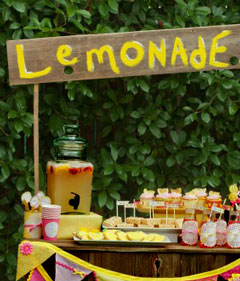 “Oh please, you don’t even remember what lemonade is. You couldn’t have been more than what, three or four years old last time you tasted it.”
“I do, too. I remember just we bought it from the kid down the street who had a stand or something. Timmy, that was his name.”
“No we didn’t,” Avril countered. “Some girl named Samantha sold it from her porch.” Pretty redheaded girl with big green eyes, maybe a year or two older than Avril. Were they friends? She doubted it.
“No, it was Timmy. Chubby kid with short black hair. He let me help sometimes. Remember? He lived in a big white house just like ours, only we had red shutters.”
“Now I know you’re just making stuff up. There weren’t any white houses . . .”
Mam shot her a look, bringing her up short.
“Yeah, there were,” Johnny continued. “Ours was the largest. Big back yard, right on the lake. Lots of tall trees. Not like the stuff we see now.” No, thought Avril, not like the gnarled, drought-starved, half-dead dwarf pines they occasionally encountered.
“Interesting. What else do you remember about our house from twelve years ago?”
“Avril, leave him be,” her mother warned in a voice heavy with resignation.
“No, I really want to know.” Avril refused to back down. “Come on, Johnny; tell us how you remember the old life.”
Johnny ignored his sister’s combative tone and considered her question. Closing his eyes against the harsh present, he ransacked his memory. If he concentrated, he could see the azure lake, the expansive emerald lawn, and the gardens dotted with pink and purple and yellow and red flowers. He could hear a neighbor’s dog barking and birds chirping. He could smell dead leaves. He could taste lemonade.
The strength of his recollections surprised him. The world through which they now moved had no lakes or lawns or flowers, no dogs or birds. Cockroaches and various reptiles scuttled across their path from time to time. Otherwise, they saw nothing living, not even other people—not anymore. There weren’t even colors. Skin, hair, clothing, earth and sky blended together, a monochromatic tapestry of grays and browns. Fine grit settled on every imaginable surface and obscured even the burnt-out vestiges of a previous existence.
Johnny took a breath.
“The walls of my room were painted light blue, like the sky—l mean, like it used to be. Avril’s room was yellow. I can’t remember Mam and Daddy’s room. The kitchen had a shiny refrigerator and a stove and an open place where we ate lunch. We had a living room with a big picture window overlooking the lake.” He looked into middle distance. “I really miss that house.”
The tiny run-down cottage where Avril spent the first seven years of her life hadn’t been painted at all. The family—Mam and Pop and her and Johnny—rented from an indifferent landlord who couldn’t be bothered with the slightest repairs. Pop spent most of the time on the road, looking for work, or so he said, so they could buy their own place. The kitchen was worn, with untrustworthy, decades-old appliances. She shared an impossibly small bedroom with her brother. She could see the lake only if she stood on the dresser and looked out the little windows up high near the ceiling, which she wasn’t supposed to do but did anyway.
The house sat directly on a busy dirt road. In the summer, heavy traffic kicked debris into the small garden where her mother tried to grow vegetables. In the autumn, the school bus threw diesel fumes and scattered dead leaves over the paltry offerings. Spring was wet and thick with mud; winter snows piled gray and slushy against the rotting windowsills.
She fought the urge to argue with her brother, to rip his recollections away from him and feed him a dose of reality. What right did she have to serve up her remembrances as the only ones of any value? Memories, even fabricated, were a rare enough luxury. The past, whatever form it took, offered more relief than the present and likely the future.
Avril turned to her mother. “Mam? What do you remember?” she asked.
“What I remember about the house,” Mam began, “was it was filled with love.” She laughed; the sound bounced off the shadows like light on the surface of a summer lake.
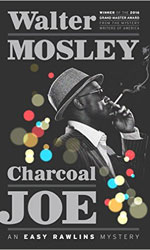 CHARCOAL JOE by Walter Mosley: I can’t think of a more consummate storyteller than Mosley. His Easy Rawlins books are studies in craftsmanship: suspenseful, well-paced, long on detail and short on excess. His ruminations on the black experience in America are unmatched among fiction writers and his evocation of particular time and place unparalleled. Even if you don’t care about any of that, you will still be entertained. Read them all or just this one.
 I started watching “Unbreakable Kimmy Schmidt” on Netflix and I can’t think of a comedy I’ve enjoyed more. It’s a valentine to resilience and to New York. Not all the jokes land, but the wit is prodigious and adorned with flashes of brilliance. Ellie Kemper is so darned likable, Tituss Burgess is the eighth wonder of the world and watching pros like Jane Krakowski and Carol Kane will make your heart sing.
 Rent “Eye in the Sky” starring Helen Mirren, the late, great Alan Rickman, Aaron Paul and many other fine actors. The movie defines suspense thriller; in the silent spaces between the action, my stomach ached from the tension. Underrated, IMHO, it’s a superb if deeply disturbing exploration of the politics and the personal involved in conducting long-distance, drone-operated warfare.
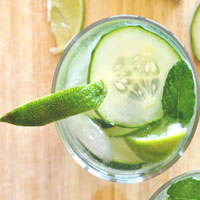 Cucumber Cooler: Combine mint, lime, gin and sugar to a shaker or closed container and shake vigorously. Then throw in cucumber slices and repeat. Leave out the gin, it’s just as refreshing. Other fun ideas are here.
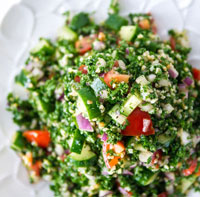 Tabouleh is a great summer dish and tastes great the day it’s made. On the other hand, it tastes even better the next day. As a side or main course, for breakfast or dinner, it’s healthy and truly satisfying. Just click on the link and you’re on your way to a simple, no cook tabouleh recipe.
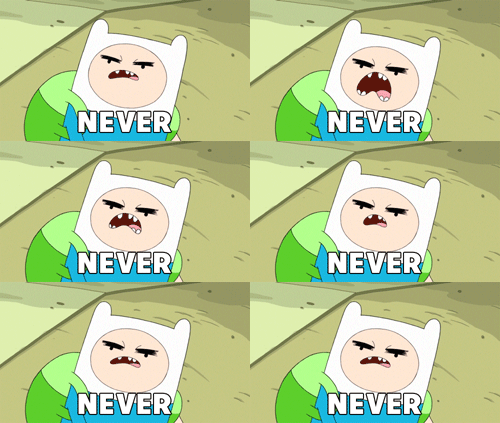 The unconditional declaration carries about it the whiff of moral superiority, especially when it’s inappropriately deployed. “I never eat meat” isn’t an offensive stance but why bring it up, as one commenter did, in a forum about the best way to cook hamburger? And if you “never watch television,” we lovers of “Game of Thrones” don’t need to hear from you.
 But in these fraught times, the never-sayers are invading discussions about more serious issues. There is no dialogue, only my (right) way and your (wrong) way. Our political leaders have set the tone. The U.S. Congress has, for eight years, said “no” and “never” to nearly everything. Now this new “never” land we walk through threatens discussion, not to mention any chance of cooperation or consensus.