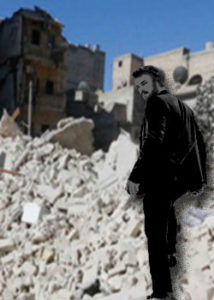
 There was a single moment of eerie calm, a soundless void over which the world was suspended between the before of what had happened—what he had caused to happen—and the after, when the trajectory of history was forever altered, at least for that place. In the space of stillness before the first screams escaped the smoldering ruins and the spiraling debris, Smith turned on his heel. With some effort, he limped away from what had been just another morning in the outdoor market.
The gravel shifting under his boots made a disproportionately loud crunch, piercing the silence and rebounding off the buildings at the edge of the town. The reverberation seemed to kick-start time itself. Then the after took over completely; an orchestrated cacophony that rose in intensity, consisting of equal parts shock, confusion, fear, and despair. Later would come anger.
He couldn’t believe he still lived. Not that his death had been part of the plan. On the other hand, no one guaranteed his survival. It was his first such assignment, after all. Older, more experienced combatants had failed in their attempts. Smith had accepted several possible outcomes with the fatalism that had accompanied him throughout other missions he’d carried out in an earlier life.
Yet here he was, heart pounding, ears ringing, arms pumping, and legs bearing him away. He was most definitely still a part of this world. The realization made him feel unexpectedly buoyant, though he was covered in brick and mortar and a thousand bits of flotsam and jetsam he would never be able to identify—and never want to.
Alive! And intact. Was it possible? It was. Smith willed himself to breathe slowly, to act dazed, which wasn’t hard to do. His adrenaline high began to fade, replaced by a sense of displacement. For a moment he allowed himself to be pushed and pulled by the flood of humanity. Some ran away from the devastation and some ran toward it. Others remained still, rendered inert by their disbelief or their injuries. He kept moving in a straight line, seeking distance.
The disaster vehicles descended on the shattered scene. Their unrelenting mechanical alarms combined with scattered cries for help to form an inhuman wailing wall of noise. The music of suffering.
Smith risked a backward glance and slowed. Falling ash blanketed the burned-out stalls and scattered detritus as survivors climbed frantically out from under, shouting for those missing, keening for those discovered dead: men, women, children, the old, the strong, the infirm, the guilty, and the innocent.
He tried to purge his mind of thoughts of death, loss, injury, and grief. It wouldn’t do to lose focus. Yet a memory surfaced, unbidden. He recalled a beautiful home reduced to rubble, the stench of something unnamable, the taste of acrid smoke, and the cries of a small child whose security had been ripped from him. He tasted bile and felt the familiar pain in his stomach.
As hurtful as his recollection was, it served to bring him back to the present turmoil and the task at hand. He’d been given a plan. Get away clean and report to the rendezvous point. He set off again at a brisk pace, swallowing repeatedly as if by doing so he could manage to digest the volatile mixture of pride and pain that clogged his throat.
Keeping his head down, Smith broke free of the crowd and moved into the shadow of an intact structure in order to catch his breath. Immediately, he sensed he was not alone. When his eyes adjusted to the shade, he saw a young boy, perhaps six or seven, his eyes tracking Smith’s every move.
He’d seen the child earlier, just before the explosion. Which means the boy must have seen Smith head into the town center with his parcel and leave again without it, his right leg dragging just a bit behind him. These were details an observant little boy might remember and be able to describe to interested adults.
Smith’s hand drifted to the weapon at his belt. He could kill the youngster. The enemy came in all sizes. Sometimes they even looked like you, although he knew that to be less and less true. He’d seen the changes reflected in the culture that had entertained him for years until he learned to despise its insistent “otherness.”
He smiled. “Hey, buddy.”
“Hello.”
“What are you doing here?”
The child looked down and kicked at the dirt. “Nothing. Watching.”
“Watching what?
The boy pointed at the ruins without raising his eyes.
“A lot to take in. What do you remember?” Smith hoped he sounded more relaxed than he felt.
“People shopping. Then there was a blast that tore everything apart.” He threw his arms out. “After that, everyone was screaming and crying.” He looked up, suddenly defiant. “I saw you walk in and walk out.”
“You have good eyes. Do you know who I am?” Smith kept his voice neutral and fought to quiet the warring voices in his head.
The boy met his gaze. There was no fear, only curiosity.
“A terrorist?”
“What? No!” Smith felt as if he’d been punched in the stomach. This is what the boy saw? Not the features that so closely mirrored the boy’s own. Not his devotion to God or love of country, at least the country he used to know. No, he saw the enemy, the very thing Smith fought.
Struggling to stay calm, he squatted in front of the boy and put his hands on the child’s shoulders.
“I’ll tell you who I am. I’m a soldier. A patriot. A hero.”
The boy looked blank. “You are? Then why did you leave? Why didn’t you help those people?”
Smith flinched. How could he make this child understand? He cast around for a reference and came back to his own childhood and the pop culture he loved and loathed. “I’m a special soldier. Like Soap MacTavish in ‘Call of Duty.’ ”
The boy’s eyes lit up. “Wow. Captain MacTavish. He was a real bad-ass.”
Smith didn’t know whether to laugh or weep. Could it be that easy? Could he lead a young mind to believe as completely as he did? Or was he taking the easy way out by gluing his truth to a video game that glorified battle for its own sake? In that moment, it didn’t matter.
“Exactly like that. Dedicated. Strong. Ready to do whatever is necessary to complete what my assignment. Does that make sense?”
“You’re a special soldier, just like Captain MacTavish.”
“Exactly,” Smith stood and smiled down at the boy.
“I need to leave now. Another job. Top secret, so let’s not mention it to anyone, okay?”
“Okay.”
Smith pulled something from his pocket. “Tell you what. Hang on to this for me until we meet again, okay?” He pressed a small sharp object into the boy’s hand and closed his fingers around it. “Protect that at all costs, soldier. Can you do that?”
“Yes, sir.” The boy clutched the gift in his hand.
Smith took off without a backward glance, filled with gratitude as well as purpose. He’d completed a difficult task without hesitation. His life had been spared. He, in turn, had spared a life. If that wasn’t God’s will, he didn’t know what was.
The boy waited until the man disappeared over the knoll. Then he unfolded his fingers and stared at the tiny American flag pin in his hand.