Jan 292020
 

“Heel” is a simple word. A body part, or a part of a shoe. As a verb, the act of repairing a shoe or a command instructing a leashed animal (usually a dog) to follow closely behind its owner.

Then there’s “heal,” which is a more complicated verb. When it comes to physical injury, the definition is “to cause (a wound, an injury, or a person) to become sound or healthy again.” The implication is that the thing or person being treated will be somehow restored. Sample sentence? “He would wait until his knee had healed.”

Then there is the second definition: “to alleviate (distress or anguish)” What it suggests is a lessening, an accommodation of sorts but not a restoration. Sample sentence? “Time can heal the pain of grief.”

Which is to say, the griever becomes far better at coping, more adept at getting through a day, open to the idea of living, laughing, loving. Never wholly repaired. Ever. Like an aging body, it will always hurt.

I’m surprised more people don’t seem to understand this about grief. Hasn’t loss touched a great number of us? Any episode of “This is Us” or the myriad doctor shows revisit the subject time after time. True, the passing of the elderly may cause less pain, though that is also fungible. Lives cut short are always a shock to the system.

Yet most people are supremely awkward around grievers. Some feel compelled to share their grief stories. Others want to flee. I get it. Listening, just listening, is hard. Being around people in pain is a colossal downer.

Writers are natural grievers. In the effort to tell stories that resonate, we must tap into universal experiences that include joy and hope but also pain and loss. We are required to feel what our narrators feel. Further, we are by nature somewhat solitary. Isolated at times by our own unruly emotions, we must rely on whatever words we have at our disposal, so that we may reach out, connect and find the truth in our own one-of-a-kind process. Such efforts may benefit others. It definitely benefits us.

As does IRL (in real life) contact. Americans may be bad with words but they are terrific huggers. Hugging isn’t for everybody and hugging everybody isn’t for me. I’m squirmy in the embrace of strangers. My family wasn’t overtly physical, although they were never at a loss for words. I’ve been a widow for eighteen years. My sister didn’t hug until the very end of her life. Being folded into an embrace is still a novelty for me.

I don’t mind it, though. It feels as if I’m connecting to something. To another being. To life.

Speaking of connecting, I know far more people now than I did when my husband was killed. Although many of these people remain virtual, others do not. They’ve stepped up. Not only are they reaching out to me, some are determined to get me out of the house. I have (what is for me) a crowded social calendar. It’s exhausting but it’s not a bad thing. I try to accept as many of these connections as possible. I’ve even done my own outreach, making dates and planning to fly off to see distant friends. That’s some sort of record.

Still, I try not to get ahead of myself. Grief drains me. I am often tired. I do practice what my friends call self-care. Less wine, less sugar, more protein, lots of exercise and the aforementioned social engagements. I am lucky to be able to do so and I don’t take that advantage for granted. I’m even grateful to keep busy with the paperwork that arises when one is solely responsible for packing up another’s life.

I’m not a patient person and age has only aggravated my impatience. I want to get on with things. Grief has other ideas about the how and the when, confounding the best laid plans.

I don’t entirely control my broken heart’s repair. For the foreseeable future, grief is the master. Where it leads, I follow. I heel, so that I can heal.

Dec 092019
 

I have been absent awhile, dear friends, fighting a battle alongside my brave sister, a battle we could not win. After nine weeks of caretaking at my house, she passed away at the very end of November, the victim of a particularly acute form of pancreatic cancer.
What most people don’t know is that in the seven months before her diagnosis, I was working with her to find answers to her intractable pain, as she sought help and treatment.

Pancreatic cancer is insidious. If it were a person, you might describe it as smart, sneaky, and implacably cruel. At times it hides from chemo designed to eradicate it. Other times it manages to weaponize the most toxic elements of the treatment to use against the patient. While no one can say why it seems to be on the rise, most experts can tell you its high mortality rate owes to the near complete absence of symptoms until it’s too late. Over half the cases, when discovered, have already metastasized. My sister’s was one of them.

However, she did have one obvious glaring symptom right from the beginning. She awoke last March to excruciating pain, which she described with great specificity to at least eight doctors over the next six months. Pain is subjective and difficult to quantify, I will grant you. It’s also dismissed all too often, particularly when it comes to older female patients.

When traditional scans failed to turn up anything (and my sister asked about pancreatic cancer twice), she and I were essentially launched, unaided into a months-long search for an answer. She visited various specialists and tried a variety of solutions. By the time we assembled a new team of doctors, which took weeks, it was far too late. Maybe it always was.

My sister—my breath, my blood, my bone, my history, my sometimes sparring partner and always best friend—died more quickly than anyone could have imagined, notwithstanding my awkward but full-hearted attempts to act as caregiver, advocate, and nurse.

She was amazing. She, so courageous despite the pain. She breathed through it, argued with it, powered over it until that became impossible. She drove with me to Canada this summer because she wanted to. She had a small dog-sitting business and she honored her contracts until she couldn’t walk. She reached out to doctors and nurses and made friends and comforted friends until the drugs and the cancer began to steal her mind. I thought I knew her, but she astounded me.

I am in shock, needless to say. How fast she disappeared, my sister for life. I’ve tried not to be angry. That’s hard, but it will pass. I have previous experience with this. It feels awful and awfully familiar. Already the scab is forming that allows me to get through each day. Inside will take a longer. I wrote her obituary. Take a look if you feel like it.

I am so thankful for the outpouring of sympathy and the support of good friends and neighbors. I am gratified by the reaction of at least one doctor who wants to review her case to see if early detection was even possible. I would like to see future patients spared at least a modicum of the pain that so adversely affected my sister’s life for nine months.

I will find my way back to my fiction, friends. I owe that to her and to you. Watch this space; I hope in a month to begin sharing with you excerpts from my new Sam Tate book.

Thank you.

Aug 282019
 

Part 1: THE VISITOR

“Where can I find the Italian?”

The old man might have been asleep. His beat-up and mud-stained cowboy hat was pulled so low his face sat mostly in shadow. Maybe he’d been watching my approach. I didn’t know, didn’t care. I’d been driving for hours. I was hot, tired, and irritated. And maybe a little nervous.
He lifted his legs off the blistered railing to bring his chair down with a thwack that sent tumbleweeds scattering. The wind whistled through the cracked pane in the old building behind him. Despite the suffocating heat, I shivered. I wanted to hightail it out of there. I stood firm, though.

Clearing my throat, I spoke again, steel reinforcing my every word. “I asked you if you’d seen the Italian. He’s got a package for me.”

The old man leaned forward a couple of inches. I couldn’t see his eyes, but I could tell he was sizing me up.

“I’m here for my wife,” I continued, my voice like steel. “She met the Italian last year. They made a deal.”

He tilted his head back. Now I could see his eyes: slits the hard gray of granite set into a lean, weathered face above a hawk-like nose and grizzled chin. They took my measure. In a voice like dry dust, he spoke. “I remember your wife.”

Those four words froze my blood. He’d met her, obviously, and she’d made an impression. How did he remember her? As a formidable opponent? A no-nonsense negotiator? Her beauty would have been obvious, along with her keen intelligence. I knew her mettle, adored her resolve, counted myself lucky every day of my life that she’d come into mine. She’d gotten past the old man; that much I knew. She’d actually reached the Italian. No small achievement. That must have rankled the cowboy/sentry in front of me.

Too sick to travel this time, she’d tasked me with locating the Italian and bringing back what was hers, no, what was ours. We were in this together. The taciturn old man with the hooded gaze wouldn’t know the specifics of their arrangement, would he? No matter. His goal was to thwart me. Mine was to retrieve the package and return home to my beloved. I had to do this, no matter the danger or the discomfort.

Fear tightened my parched throat. I took a breath, blew it out with as much force as I could muster. “The Italian,” I growled. “He was supposed to leave us a package. He got his money. I’m not leaving until I get it.” I spread my legs apart and folded my arms to show I meant business.

The old man’s lips parted, revealing tobacco-stained teeth. He hauled himself out of the chair and drew himself up to his full height, well past six feet. Standing above me on the porch, he reminded me of a tree, unyielding and unbending.

“How ‘bout you describe this package?” The old man spoke quietly, weight in every word.

I held out my hands to indicate an oblong shape maybe twelve inches long, curling them slightly to represent a cylinder.

He chuckled, a harsh unforgiving sound. “Big as a breadbox, eh? You must want it bad to come here on your own.”

I ignored his veiled threat, kept my voice steady. “I’m more than capable of handling this on my own.” I gave him my best snake eye. “Deal’s a deal. I paid for it and I want it now.”

We faced each other for what might have been a minute, neither of us giving ground until he finally looked away. He offered a grimace, walked down the stairs, and clamped a hand on my shoulder. He indicated the house and I followed, determined to finish the job.

In the end, I walked out of there with my head held high and the package tucked under my arm. That’s what counts.


PART TWO: The Old Man

“Where can I find the Italian?”

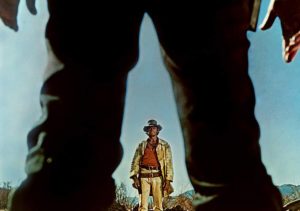
(courtesy, the Everett Collection)

The man didn’t startle me, mainly because he’d announced his arrival long before he posed his

question. He’d shown up in a white Ford Fusion with a bad muffler and a couple of sad little dings—a rental, judging by the plates. He’d heaved himself out of that sorry vehicle with a grunt, as if the effort of standing were too much for him. Now he stood below me, peering from under the brim of his ridiculous white cowboy hat. I lifted my legs off the railing, setting down the chair with a thwack that sent tumbleweeds scattering.

“I asked you if you’d seen the Italian,” he repeated, his voice breaking.

I leaned forward, taking in his starched chambray shirt, pressed new jeans, pointy new boots, and oversized belt buckle. He looked worse than a caricature of a cowboy; he looked like a fool. Clearly not from around these parts.

“I asked you if you’d seen the Italian,” he said in a voice so choked I could scarcely hear him. “He’s got a package for me.” He sounded like a little kid asking for candy at the five and dime, poor fella.

“I remember your wife,” I told him. Indeed I did. Mouthy woman, real pushy. Wouldn’t take no for an answer. Couldn’t scarcely call her pretty, she was so pulled and pinched. All bleached out, too. She reminded me of a lemon. She actually tried to flirt with me in that scratchy purring voice of hers, posing her skinny body like I’d be interested. When that didn’t work, she got kinda prickly, like the world owed her a favor. No more kitty-cat; she was all shrill business. Pushed right past me. I wasn’t about to hit a woman, though I was sorely tempted, let me tell you.

The city slicker kept yammering in his tight little voice.  Something about the package he’d paid for and how he wouldn’t leave until he got it. He stood there, legs spread and arms wrapped around like his torso like he had some kind of intestinal disorder. I had to work some to keep myself from laughing.

I stood up, mostly to stretch my legs but also to get a better look. I swear he cringed. “How ‘bout you describe this package?” I suggested.

Darn if he didn’t hold out his little hands like a schoolboy describing the lunch he lost. I guess I must have chuckled at that. “Big as a breadbox, eh?” I recall saying. “You must want it bad to come here on your own.” Without your pushy wife, I could have added.

““I’m more than capable of handling this on my own,” he replied with a quaver that gave lie to his words. “Deal’s a deal. I want what I paid for.”

He was trying to sound tough. Honestly, it wasn’t working. For one thing, he was practically shaking in his fancy boots. He tried to stare me down but he kept looking away.

Time to end this show, I thought. The Missus swears I’m trying to scare the tourists. Hell, I’m just having a little fun. Anyway, I flashed him my kindliest grin, walked down the steps and clamped a hand on his shoulder. He flinched.

“I reckon if it means bread enough to bring you out on a scorcher like today, you damn well deserve it. Pasquale doesn’t like visitors, as I told your wife last time she was here. Interrupts his creative process, or so he tells me. We can make an exception though, just like we did for your spouse.” Who almost didn’t get through the door, thanks to the Missus. I suppressed another grin. My wife is protective of her employees.

“Let’s get you something to drink. I’ll even give you a quick tour of the bakery. Then you can be on your way with the best prosciutto bread around these parts.”